test

Ends in:
test
Skip to content
Scholarsight
Introduction to Correlations Using SPSS cover
Data Analysis and Research

Introduction to Correlations Using SPSS

0 students
Last updated Jul 2026

Course Overview

About This Course

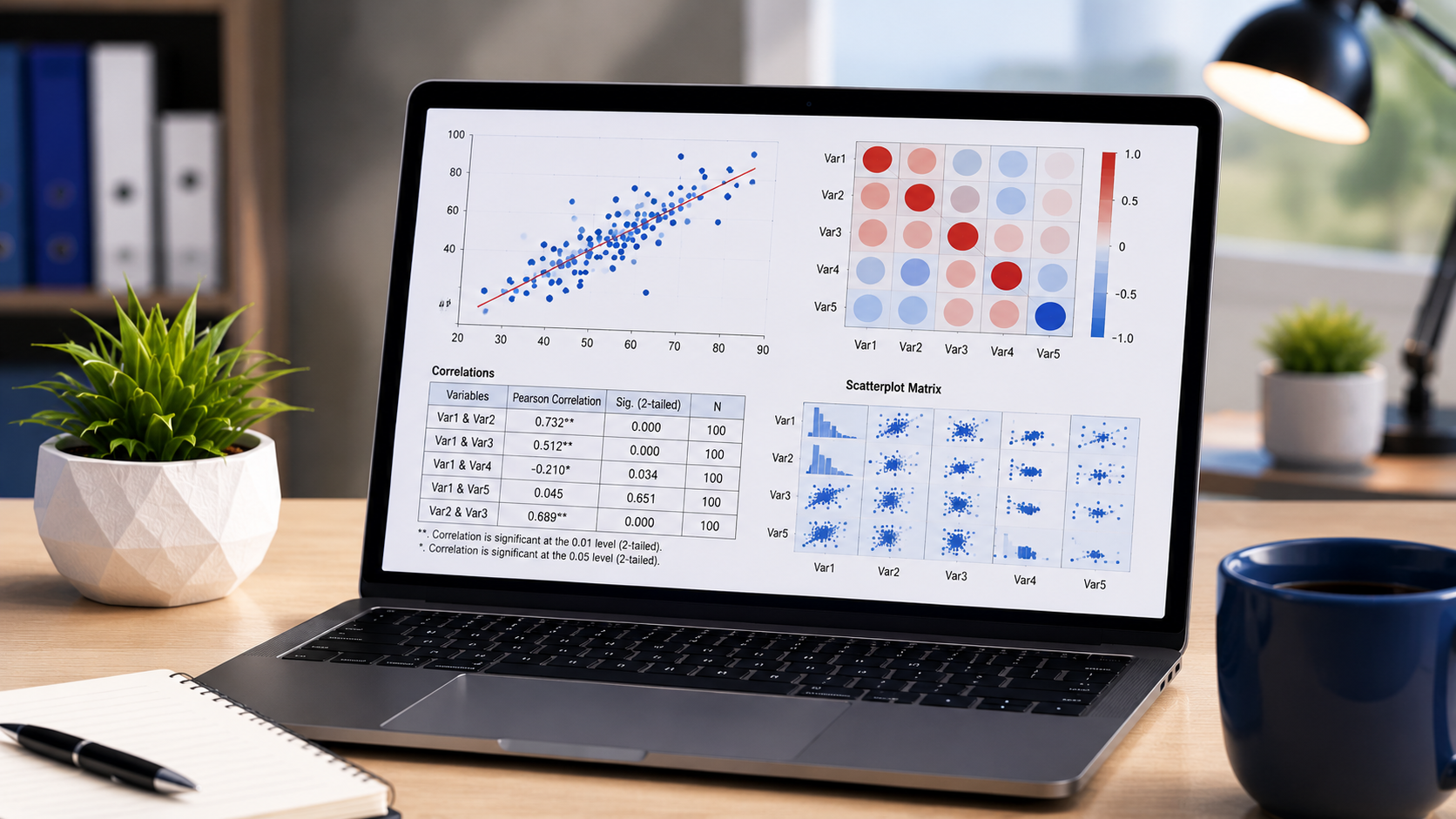
Welcome to Correlational Analysis Using IBM SPSS Statistics, a comprehensive course designed to help you master one of the most widely used statistical techniques for measuring relationships between variables. Whether you are a student, researcher, academic, or data analyst, this course provides the conceptual knowledge and practical skills needed to perform and interpret various correlation analyses using IBM SPSS Statistics.


The course begins with the fundamentals of correlational analysis, explaining when and why different correlation techniques should be used. You will learn the concepts, assumptions, calculations, and interpretations of Pearson's Correlation, Spearman's Rank Order Correlation, Biserial Correlation, and Point-Biserial Correlation. Through step-by-step demonstrations in SPSS, practical examples, and real-world datasets, you will gain hands-on experience in conducting correlation analyses, interpreting outputs, testing hypotheses, and reporting results according to APA style.


By the end of this course, you will have the confidence to perform correlational analysis using IBM SPSS Statistics and apply these techniques effectively in academic research, dissertations, theses, and professional data analysis.


Learning Outcomes

Understand the concepts, assumptions, and applications of correlational analysis.

Perform and interpret Pearson's, Spearman's, Biserial, and Point-Biserial correlations using IBM SPSS Statistics.

Select the appropriate correlation technique for different types of research data.

Test research hypotheses and interpret correlation outputs accurately.

Report correlation analysis results in APA style and research-standard format.

Curriculum

4 Sections • 41 Lectures
Introduction to Correlation
1:45
What is Correlation?
1:19
Types of Correlations: Positive and Negative Correlations
3:42
Understanding Correlation Coefficient and its Range
3:26
Which Correlation Coefficient to Use and When?
8:56
Dataset and Resources
0:08
Pearson's Correlation: Origin, Use & Why its so Popular?
3:10
Why it is Called Product Moment Correlation Coefficient?
2:33
Assumptions of Pearson's Product Moment Correlation
6:38
Calculation of r: Deviation Score formula
1:32
Calculation of r: Z-Score Formula
1:24
Calculation of r: Raw Score Formula
2:06
Calculation of r: Co-variance Formula
2:42
Manual Calculation of r using Raw Score Method
2:34
Importance of r
2:13
Spurious Correlations: When Correlation Does Not Signify Causation?
3:15
Pearson Correlation as a Coefficient of Variability (R-squared)
2:54
Checking Assumptions of r
11:26
Understanding Pearson, Two tailed, and Bootstrapping
4:42
Interpretation of Output of r
0:51
Bootstrapping the Correlation Coefficient (r)
1:25
Writing Output of r in APA style
9:49
Fixing the Bootstrap Bug in SPSS 25
10:55
Introduction to Biserial and Point-Biserial Correlations
2:20
When to Use Biserial and When to Use Point-Biserial Correlation?
3:47
Calculation and Interpretation of Biserial Correlation in SPSS
4:42
APA Style Reporting of Biserial Correlation Output
0:49
Exercise: Calculating a Point Biserial Correlation between Gender and Salary
0:58
How to Calculate Point-Biserial Correlation in SPSS?
1:45
Interpreting Point Biserial Correlation Output in SPSS
3:01
Reporting Point-Biserial Correlation Output in APA style
2:45
Introduction to Rho
0:30
When to Use Rho?
2:45
Origin and Notation of Rho
0:14
Assumptions of Rho
6:48
Understanding the Formula of Rho and Ranking Method
3:07
How to Deal with Tied Ranks While Calculating Rho
3:55
Should I Rank My Variables First then Calculate Rho in SPSS?
0:28
Calculating and Interpreting Rho in SPSS
2:02
Rho is r on Ranked Data: Proof
3:04
APA Style Reporting of Rho
1:48
Meet your instructors

Learn from Experts and Leaders

4.5
Rating
1
Reviews
4
Students
25
Courses

An experienced and passionate instructor, [Name] is dedicated to fostering a dynamic and engaging learning environment where students feel motivated to grow both academically and personally. With a strong foundation in their subject area, they bring clarity, structure, and enthusiasm to every lesson, ensuring complex concepts are made accessible and relevant. Their teaching approach blends theoretical knowledge with practical application, encouraging students to think critically and develop problem-solving skills. Known for their supportive and approachable demeanor, [Name] builds meaningful connections with students, understanding that each learner has unique strengths and challenges. They are committed to creating an inclusive classroom atmosphere where curiosity is encouraged, questions are welcomed, and every student feels valued. By adapting teaching methods to suit diverse learning styles, they help students gain confidence and achieve their full potential. Beyond the classroom, [Name] is deeply invested in continuous learning and professional development, staying updated with the latest educational practices and advancements in their field. They often contribute to curriculum development, mentorship programs, and extracurricular activities, reinforcing their role as not just an instructor, but a mentor and guide. Their ultimate goal is to inspire lifelong learning and empower students to succeed in an ever-evolving world.

More

Reviews

0.0

0 reviews

All Reviews

No reviews yet

Be the first to share your experience with this course!

Expand Your Knowledge

Related Courses

Course preview

Preview

Loading preview...

Preview Unavailable

Forgot?