test

Ends in:
test
Skip to content
Scholarsight

Moderation and Mediation Analysis using PROCESS in SPSS

Welcome to Moderation and Mediation Analysis Using IBM SPSS Statistics and PROCESS Macro, a comprehensive course designed to help you understand and apply two of the most powerful...

0 learners
Advanced
Published 2026 · Last updated Jul 2026

Moderation and Mediation Analysis using PROCESS in SPSS

lifetime access

View degree tracks

Course overview

Course Overview

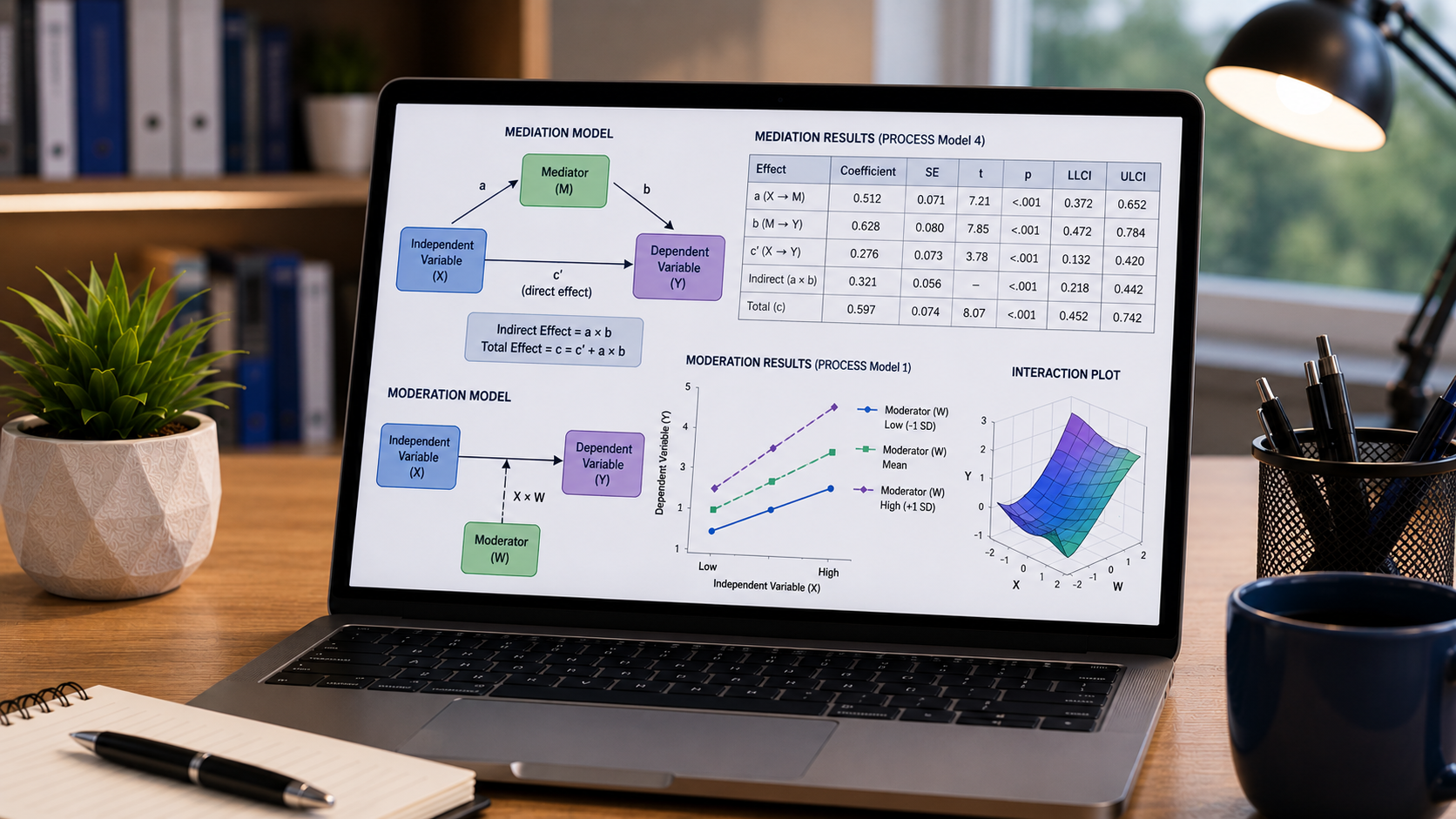
Welcome to Moderation and Mediation Analysis Using IBM SPSS Statistics and PROCESS Macro, a comprehensive course designed to help you understand and apply two of the most powerful techniques for examining complex relationships between variables. Whether you are a student, researcher, academic, or data analyst, this course provides both the theoretical foundation and practical skills required to conduct moderation and mediation analyses using IBM SPSS Statistics and the PROCESS Macro developed by Prof. Andrew F. Hayes.


The course introduces the concepts of mediation and moderation, explaining their purpose, assumptions, and applications in behavioral, social, business, health, and educational research. You will learn how to install and use the PROCESS Macro, specify appropriate models, perform mediation and moderation analyses, interpret direct, indirect, and conditional effects, understand bootstrap confidence intervals, and report findings according to APA style. Through step-by-step demonstrations and practical examples, you will gain hands-on experience in testing research hypotheses and interpreting complex statistical relationships.


By the end of this course, you will have the confidence to perform moderation and mediation analyses using PROCESS Macro in IBM SPSS Statistics and apply these techniques effectively in academic research, dissertations, theses, and professional data analysis.



Learning Outcomes

Understand the concepts, assumptions, and applications of moderation and mediation analysis.

Perform moderation and mediation analyses using IBM SPSS Statistics and the PROCESS Macro.

Test and interpret direct, indirect, and conditional effects in research models.

Develop and evaluate research hypotheses involving mediation and moderation relationships.

Report moderation and mediation analysis results in APA style and research-standard format.

What you walk away with

Career Map & Skills You Gain

Every course adds to three macro skills. Log in to swap platform averages for your own numbers.

Financial skills

62th

percentile

Your salary vs. learners in these roles

After this course+14 pts → 76th

Data Analysis and Research specialist

72% course score

+7

Project contributor

66% course score

+7

Independent practitioner

61% course score

+6

Employability skills

71th

percentile

Quiz scores from the courses you finish

After this course+18 pts → 89th

Understand the concepts, assumptions, and applications of moderation and mediation analysis

64% course score

+6 pts

Perform moderation and mediation analyses using IBM SPSS Statistics and the PROCESS Macro

70% course score

+7 pts

Test and interpret direct, indirect, and conditional effects in research models

76% course score

+8 pts

Develop and evaluate research hypotheses involving mediation and moderation relationships

82% course score

+8 pts

Life skills

48th

percentile

Life-skill test scores after each course

After this course+11 pts → 59th

Critical thinking

76% course score

+8 pts

Decision-making

71% course score

+7 pts

Confidence

68% course score

+7 pts

Curriculum

4 modules · 48 lessons · 0 min

Each module pairs the hand calculation with the same analysis in Excel, SPSS, R and Python.

Introduction to Mediation and Moderation Analysis
4:12
Downloading & Installing Process Macro
9:50
Dataset and Resources
0:26
Journal Articles
0:35
Understanding Moderation analysis and its Regression Model: Part - 1
4:04
Understanding Moderation analysis and its Regression Model: Part - 2
10:49
Statistical Equation of Moderation
5:50
Examples of Moderation
7:31
Understanding Mediation: Direct, Indirect and Total Effects
4:39
Understanding Difference Between Moderation & Mediation
9:46
What is Mediation? Understanding a Mediation Model
3:31
Whats is Full n Partial Mediation?
2:19
Understanding Direct Indirect & Total Effects
4:39
What is Sobel Test?
1:26
Understanding Partially Standardized vs Completely Standardized Indirect Effects
3:37
Understanding Ratios of Indirect effect: Indirect to Total vs Indirect to Direct
2:24
What is 'Proportion of Variance Explained by Indirect Effect'?
2:04
Moderation analysis: Dataset & Hypothesis Development
9:45
Understanding Model Numbers
5:14
Moderation Variables, Bootstrapping, Covariates, Proposed Moderator W,Z, V, Q
2:17
Moderation Options: Mean Center for Products
1:35
Understanding Heteroscedasticity Consistent SE, OLSML CI, Data Plotting
1:30
Understanding Conditioning Johnson-Neyman
1:47
Understanding Moderation Multi-categorical Option
0:47
Dealing with Long Variable Names
1:04
Explanation of Output of Moderation Analysis
17:44
Plotting Moderation effect in SPSS and Excel
7:55
APA Style Presentation of Moderation Effect, Chart and Table
2:44
Word File of APA Style Results
1:00
Conceptual Model of Mediation
3:14
Checking Suitability of Data for Mediation Analysis
3:27
Understanding M-Variables, Model Number, Bootstrap Sample, and Covariates
4:04
OLSML Confidence Interval & Effect Size Options
1:55
Sobel Test Option
1:50
Total Effect Model, Compare Indirect Effect, Print Model Cov Options
1:48
Mediation Conditioning, Multi-categorical, and Long Names
2:20
Understanding Covariance Matrix Output
1:45
Explaining Mediation Output: Part 1
3:28
Explaining Mediation Output: Part 2
4:29
Explaining Mediation Output: Part 3
3:02
Partially and Fully Standardized Indirect Effects Output
5:02
Ratio of Indirect to Total Effect & Indirect to Direct Effect: Explaining Output
1:16
R-squared & Mediation Effect Size
0:29
Explaining Normal Theory Test for Indirect Effect
0:41
Kappa Squared: Why It is Suppressed?
1:29
Calculating Preacher and Kelly's Kappa Squared Manually
9:48
APA Style Presentation of the Results of Mediation Analysis
2:35
Word File of APA Style Result of Mediation Analysis
1:00

Degree Track Only

This course is available inside a Degree Track and cannot be purchased separately.

View Tracks

Reviews

What learners say

You need to have access to this course to write a review

Buy Now
0.0

0 reviews

  • No reviews yet.

Questions

Frequently asked

Who is this course for?

This course is designed for learners who want a practical, guided path through Data Analysis and Research.

What will I learn?

Understand the concepts, assumptions, and applications of moderation and mediation analysis. Perform moderation and mediation analyses using IBM SPSS Statistics and the PROCESS Macro. Test and interpret direct, indirect, and conditional eff...

How long do I have access?

Your course access remains available for the lifetime of your account, including future updates to the lessons.

Is there a refund?

Yes. Eligible purchases include the platform money-back guarantee described at checkout.

We are committed to your progress

Lifetime access, mentor Q&A on every lesson, and a certificate you can share the moment you finish. If it is not right for you, the first 30 days are on us.

Start this learning path

Course preview

Preview

Loading preview...

Preview Unavailable

Forgot?