test

Ends in:
test
Skip to content
Scholarsight
Moderation and Mediation Analysis using PROCESS in SPSS cover
Data Analysis and Research

Moderation and Mediation Analysis using PROCESS in SPSS

0 students
Last updated Jul 2026

Course Overview

About This Course

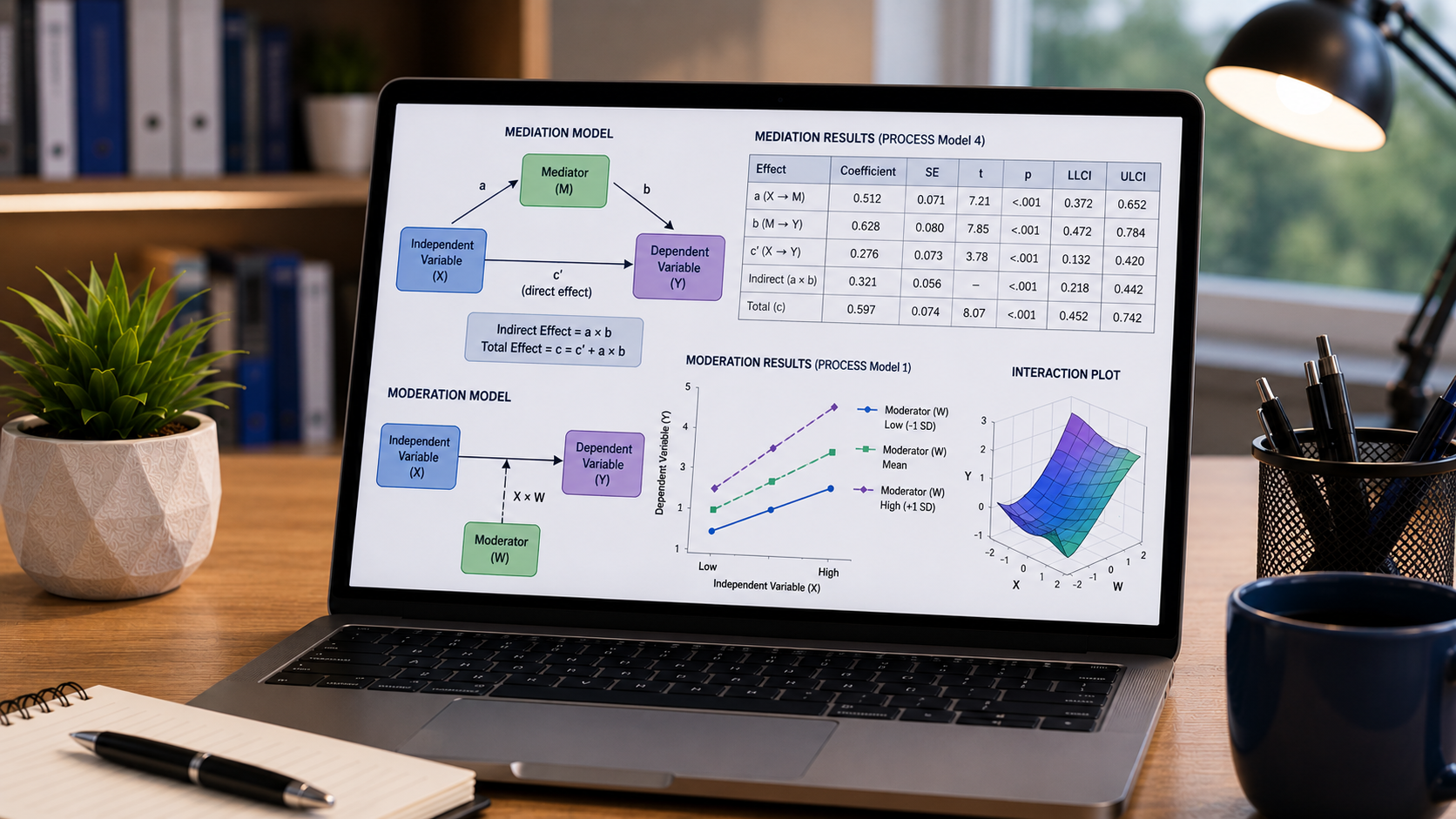
Welcome to Moderation and Mediation Analysis Using IBM SPSS Statistics and PROCESS Macro, a comprehensive course designed to help you understand and apply two of the most powerful techniques for examining complex relationships between variables. Whether you are a student, researcher, academic, or data analyst, this course provides both the theoretical foundation and practical skills required to conduct moderation and mediation analyses using IBM SPSS Statistics and the PROCESS Macro developed by Prof. Andrew F. Hayes.


The course introduces the concepts of mediation and moderation, explaining their purpose, assumptions, and applications in behavioral, social, business, health, and educational research. You will learn how to install and use the PROCESS Macro, specify appropriate models, perform mediation and moderation analyses, interpret direct, indirect, and conditional effects, understand bootstrap confidence intervals, and report findings according to APA style. Through step-by-step demonstrations and practical examples, you will gain hands-on experience in testing research hypotheses and interpreting complex statistical relationships.


By the end of this course, you will have the confidence to perform moderation and mediation analyses using PROCESS Macro in IBM SPSS Statistics and apply these techniques effectively in academic research, dissertations, theses, and professional data analysis.


Learning Outcomes

Understand the concepts, assumptions, and applications of moderation and mediation analysis.

Perform moderation and mediation analyses using IBM SPSS Statistics and the PROCESS Macro.

Test and interpret direct, indirect, and conditional effects in research models.

Develop and evaluate research hypotheses involving mediation and moderation relationships.

Report moderation and mediation analysis results in APA style and research-standard format.

Curriculum

4 Sections • 48 Lectures
Introduction to Mediation and Moderation Analysis
4:12
Downloading & Installing Process Macro
9:50
Dataset and Resources
0:26
Journal Articles
0:35
Understanding Moderation analysis and its Regression Model: Part - 1
4:04
Understanding Moderation analysis and its Regression Model: Part - 2
10:49
Statistical Equation of Moderation
5:50
Examples of Moderation
7:31
Understanding Mediation: Direct, Indirect and Total Effects
4:39
Understanding Difference Between Moderation & Mediation
9:46
What is Mediation? Understanding a Mediation Model
3:31
Whats is Full n Partial Mediation?
2:19
Understanding Direct Indirect & Total Effects
4:39
What is Sobel Test?
1:26
Understanding Partially Standardized vs Completely Standardized Indirect Effects
3:37
Understanding Ratios of Indirect effect: Indirect to Total vs Indirect to Direct
2:24
What is 'Proportion of Variance Explained by Indirect Effect'?
2:04
Moderation analysis: Dataset & Hypothesis Development
9:45
Understanding Model Numbers
5:14
Moderation Variables, Bootstrapping, Covariates, Proposed Moderator W,Z, V, Q
2:17
Moderation Options: Mean Center for Products
1:35
Understanding Heteroscedasticity Consistent SE, OLSML CI, Data Plotting
1:30
Understanding Conditioning Johnson-Neyman
1:47
Understanding Moderation Multi-categorical Option
0:47
Dealing with Long Variable Names
1:04
Explanation of Output of Moderation Analysis
17:44
Plotting Moderation effect in SPSS and Excel
7:55
APA Style Presentation of Moderation Effect, Chart and Table
2:44
Word File of APA Style Results
1:00
Conceptual Model of Mediation
3:14
Checking Suitability of Data for Mediation Analysis
3:27
Understanding M-Variables, Model Number, Bootstrap Sample, and Covariates
4:04
OLSML Confidence Interval & Effect Size Options
1:55
Sobel Test Option
1:50
Total Effect Model, Compare Indirect Effect, Print Model Cov Options
1:48
Mediation Conditioning, Multi-categorical, and Long Names
2:20
Understanding Covariance Matrix Output
1:45
Explaining Mediation Output: Part 1
3:28
Explaining Mediation Output: Part 2
4:29
Explaining Mediation Output: Part 3
3:02
Partially and Fully Standardized Indirect Effects Output
5:02
Ratio of Indirect to Total Effect & Indirect to Direct Effect: Explaining Output
1:16
R-squared & Mediation Effect Size
0:29
Explaining Normal Theory Test for Indirect Effect
0:41
Kappa Squared: Why It is Suppressed?
1:29
Calculating Preacher and Kelly's Kappa Squared Manually
9:48
APA Style Presentation of the Results of Mediation Analysis
2:35
Word File of APA Style Result of Mediation Analysis
1:00

Degree Track Only

This course is available inside a Degree Track and cannot be purchased separately.

View Tracks
Meet your instructors

Learn from Experts and Leaders

4.5
Rating
1
Reviews
4
Students
25
Courses

An experienced and passionate instructor, [Name] is dedicated to fostering a dynamic and engaging learning environment where students feel motivated to grow both academically and personally. With a strong foundation in their subject area, they bring clarity, structure, and enthusiasm to every lesson, ensuring complex concepts are made accessible and relevant. Their teaching approach blends theoretical knowledge with practical application, encouraging students to think critically and develop problem-solving skills. Known for their supportive and approachable demeanor, [Name] builds meaningful connections with students, understanding that each learner has unique strengths and challenges. They are committed to creating an inclusive classroom atmosphere where curiosity is encouraged, questions are welcomed, and every student feels valued. By adapting teaching methods to suit diverse learning styles, they help students gain confidence and achieve their full potential. Beyond the classroom, [Name] is deeply invested in continuous learning and professional development, staying updated with the latest educational practices and advancements in their field. They often contribute to curriculum development, mentorship programs, and extracurricular activities, reinforcing their role as not just an instructor, but a mentor and guide. Their ultimate goal is to inspire lifelong learning and empower students to succeed in an ever-evolving world.

More

Reviews

0.0

0 reviews

All Reviews

No reviews yet

Be the first to share your experience with this course!

Expand Your Knowledge

Related Courses

Course preview

Preview

Loading preview...

Preview Unavailable

Forgot?